Wednesday, May 22, 2013

Call Ratio Spread Strategy.

This strategy can be used in a situation when a stock position that one holds has gone down in value considerably and one would like to get out of the position gracefully with minimal downside (potentially a profit!). This strategy is contrary to selling the stock at a loss or holding onto it in the hope it will rise back to the initial entry position. 

Premise: Stock is going to increase sometime into the future

Initial Entry into position and situation:

Trader Joe bought 100 shares of stock A at $160 in January 2013.
Stock A falls to $137 in a month.
Trader Joe does not want to sell the position.

Call ratio spread:

  • Buy one May 135 call for $14
  • Sell two May 150 calls for $7.50 a piece
  • A net credit of $1 (7.50 * 2 - 14) is collected

Scenarios:

Following scenarios are possible.

Decline: 

Stock A continues to decline below $137, all calls expire worthless and Trader Joe keeps net credit less commissions). Downside is stock loses more value.

Flat: 

Stock A stays between the value of the two calls ($135 and $150). The short calls expire worthless, while the long call will become in-the-money and potentially can generate a profit.

Rises:

Stock A moves above $150. The two short calls will likely be exercised but both are covered (one by the long stock position and the other by the long call position).

For any potential upside, Trader Joe will not be able to get any benefit.

Assumptions:

Trader Joe is confident and expects from his research that this stock will move up as the current decline is due to margin calls that may have been raised because of a short term decline in the stock.

Conclusion:

Hold the stock:

Trader Joe holds onto the stock until it reaches $160 to break even. (up by 16.8%)

Sell the stock now:

Cut the loss at $23 a share ($2300 loss)

Stock Repair:

Upside breakeven lowered to $147. (up 8.8%)
Note: Max profit potential limited to $600. Loss to the downside lessened by $100 credit received.

Double up to catch up:

Double the risk of a losing position (Cut losses, let profits run!)

Management Responsibility:

Advanced strategy requires monitoring of the positions

What is your exposure?

Delta=exposure to price moves

  • Lower initially

Gamma=change in exposure to price moves

  • Negative

Theta=time decay

  • Positive

Vega=exposure to change in implied volatility

  • Negative

Expiration Responsibilities!

All calls OTM (Stock A is below $135) -> No action required

Both legs expire worthless, Trader Joe keeps a small compensation in the form of $100 credit

All calls ITM (Stock A above $150) -> Legs will auto exercise

Long shares cover one short 150 call, long 135 call covers the second short 150 call

Long call ITM (Stock A between 135 and 150) -> Exercise/sell long call for a profit

Monday, September 10, 2012

Vertical Calendar Spread


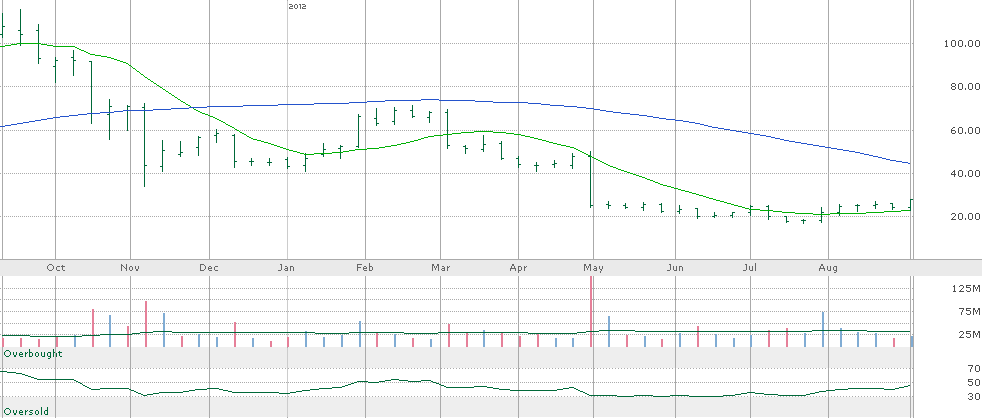
Green Mountain Coffee Roasters (GMCR) has taken a pounding over the past year, and investors want to know if this is an overreaction to the company's K-cup patent expiration this month, or if there is more pain to be had. GMCR has had a roller-coaster year, from its high of almost $116 to its low of $17.11, and back to the $27-range where it currently stands.
(click to enlarge)
Over the past 12 months, GMCR has grown its revenues by 56.76%, compared with only a 9.25% growth average across the food processing industry. They have also grown their earnings per share by an astounding 112.54% compared with a negative 26.6% growth rate across the industry. GMCR currently trades at 12.8 times earnings, a significant discount to competitors such as Starbucks (SBUX), which trades at a 28.53 multiple and has a much lower 12.69% revenue growth rate over the past 12 months. Additionally, GMCR operates at a 33.30% gross profit margin, compared to 26.40% for Starbucks. Of the 10 analysts who provide price targets on GMCR, there is a $36.60 average 12-month price target, with a low estimate of $25.00 and a high of $60.00.
Additionally, the popularity of their products is not going anywhere. Data aside, even the novice investor can observe the rate at which Keurig machines are popping up all over the place. It is estimated that over 7.5 Keurig brewers had been sold as of late 2010, and the company itself reported that over 4 million Keurigs sold during the 2011 holiday season alone. During that same time period, over $715 million in K-cup packs, according to a February 2012 New York Times article. From 2010 to 2011, the amount of K-cup brewers sold doubled year over year.
With the K-cup patents set to expire, of course there will be some loss of sales from other manufactures of the single-serve coffee cups, however the potential for future growth should more than make up for this. Single-serve coffee makes up only 8% of the global market for home-brewed coffee, and is rapidly growing. Additionally, I believe that the patent expirations are already fully factored into the share price; however the anticipated slow growth has been overstated.
Admittedly, there is a lot of uncertainty surrounding GMCR in the upcoming months. Instead of purchasing the stock outright, I recommend playing GMCR with January 2014 calls using a vertical spread. My trade is to buy the Jan '14 $25 calls for a debit of $8.90. Then, sell the $50 calls of the same expiration for a credit of $2.20, for a net debit of $6.70.
This trade makes money if GMCR is above $31.70 by January 2014, which is only 13.9% above its Friday close of $27.83, and far below the average price target of $36.60. Maximum profit is achieved if GMCR is priced at $50 or more at expiration, with profit capped at $25.00-$6.70=$18.30. This ideal case would represent a 273% gain on your investment. While you are giving up some potential gains above a $50 share price, I like this trade because it limits your potential losses to the premium paid, $6.70. Even with the uncertainty in GMCR's future, this trade produces a risk/reward that is hard to ignore.

Thursday, March 29, 2012

200-day moving average

When researching a stock, investors can use both Fundamental Analysis and Technical Analysis to help determine whether that stock is a good buy -- or a good sell.


Many investors are the most familiar with Fundamental Analysis -- what's happening in the underlying business, its earnings, revenues, balance sheet, and how the management is doing running things.


But then there's Technical Analysis, which looks only at the trading data for the stock -- the real life supply and demand for the stock over time -- and examining that data in different ways.


One of these ways is to calculate an average of the closing prices for the last 200 trading sessions. Doing this calculation for each day going backwards in time shows how that 200-day average has moved -- hence the term "200-Day Moving Average."


The reason why the 200-Day Moving Average in particular is so popular in Technical Analysis is because historically it has been used with profitable results to time the market. One popular timing strategy is to be invested in the S&P 500 ETF (AMEX:SPY) when it is above its 200-Day Moving Average, and move to cash when it goes below it.


With individual stocks, investors can benefit from being alerted when a stock rises above, or falls below, its 200-Day Moving Average, and then use Fundamental Analysis to help determine whether the technical signal is a buying opportunity, or a "look out below" warning. 

Thursday, January 26, 2012

Covered Call

When to close covered calls?

The simplest way of trading covered calls is just to write them and let them go to expiration. This is the easiest strategy and probably the one most covered call writers use. However, covered calls frequently present the opportunity to get out of the trade early for great profits or to minimize a potential loss. While it is by no means always necessary to close a covered call position before expiration of the calls sold, there are several situations that call for an early close.

The Four Exits

Covered call writers, like all traders, should enter a trade with a reasoned trading plan. Specifically, the trader should know the profit being sought and the stop-loss point at which to exit the trade in order to minimize losses in the event the trade goes wrong. There are four instances in which a covered call position should be closed (by repurchasing the calls and selling the stock) instead of letting it go to expiration:
 

1.  When closing the position will yield the profit planned by the trader.

This point presupposes that the trader actually went into the trade with a plan. For example, a covered call trade may upon entry set up a potential profit of 5.5% flat and 10% if called with a 30-day trade duration, but the trader has planned to close the position if a 3.5% profit presents itself in the first two weeks (which would be equivalent to a return of over 7% for 30 days). Many covered call writers plan trades in this manner.
 

2.  When closing the position will yield a profit that is acceptable to the trader in light of time remaining to expiration and other trade considerations.

This point may seem like a duplicate of the first one, but it is not. Even the trader who is loath to plan trades and does no more than the basic research and technical analysis before trading should be aware when the trade presents a profitable early exit. The fact is that high covered call premium implies higher than normal volatility. But if the market's expectations concerning a stock should change before expiration, the implied volatility will collapse. For this reason, it frequently is possible to exit a trade early with a nice profit.

Not every trade presents an acceptable early exit, and even those that do will not always present a profit that is as high as the profit expected if the trade goes to expiration. However, exiting the position terminates trade risk, locks in a profit, and frees the trader's funds for other trades. How much profit is enough? That depends on the trader's viewpoint. Besides, keep the profit proportions in mind. For example, if a trade with an expected duration of 30 days sets up a 5% profit and it is possible to close it for a 2.8% profit after 10 days, this works out to an 8.4% profit for 30 days. In other words, to calculate the real return, you must match the return to the trade duration.

For those traders who ask us if they should always be watching stock and call prices on open trades, we firmly believe that every position should be looked at at least a few times daily. This is partly to watch for an adverse move in the stock and partly to be aware of opportunities for a profitable early close.

    Note: Sometimes it is better to close the short call only instead of the entire position, meaning to buy back the calls sold but not sell the stock. This is the case where the stock is showing technical strength and you expect it to go up, and the call can be bought back at a profit. Some covered call writers make it a habit to close out calls when they can be bought back for 25% of the premium received. If the stock has not dropped correspondingly with the call premium, this is always a profitable maneuver.

3. Regarding in-the-money (ITM) calls on underlying stock that you do not want to have called away: close it when all the time value has evaporated.
Premiums on ITM calls have two value components: the part that is in the money (below the stock's price) is known as intrinsic value, and the part of the premium that is above the stock price and not in the money is known as the time value. At-the-money and out-of-the-money call premiums are all time value, of course. On every option sold, the profit is all in the time value. For this reason, it is highly unusual for options to be exercised before expiration when there is any time value left. However, when the time value disappears, ITM calls can be exercised at any time, and the covered call writer is in danger of assignment and losing the shares.

For example, if you buy a stock for $16 and write an ITM 15 Call for a $1.50 premium, then $1.00 of the premium is intrinsic value and $0.50 is time value. If the premium drops to $1.00, all of the time value has evaporated, which means the calls might be exercised at any time. If the calls begin trading at a discount, meaning less than intrinsic value, the danger of early assignment rises dramatically.


4. When the stock has violated the trader's stop-loss point.

We firmly believe that every trade has to be entered knowing the stop-loss point - -that is, the point at which the trader will close the trade if the stock drops far enough. No two traders will necessarily set the stop loss at the same price, but trading discipline dictates that the worst case be planned for. Ideally, the stop-loss point will be above the trade's breakeven point, so that it can be closed without a loss or only a very small loss. While there is not room in this article to thoroughly discuss the stop-loss point, we are believers in not closing trades until a support level has been violated, because stock prices oscillate, and a stock can pull back to the breakeven point and recover just fine. For this reason, the place for effective stops in our experience is right below support. Support can be a trend line, 50-day moving average or traditional support level.But the important point is to have a stop loss set when the trade is run, whether the stop is a mental one or a trade order. If you are not in a position to watch the trade, it is better to enter a stop order with your broker just in case the stock drops unexpectedly.

    Note: An alternative to closing the position when the stock has dropped to the stop loss point or close to it is to buy back the short call and sell a deeper ITM call, which is known as rolling the call down. Although in this instance the stock has dropped, the trader usually picks up a profit on buying back the call. The sale of the deeper ITM call brings in more premium, which gives much more downside protection and lowers the trade's breakeven point. You have to do the math on each trade to see if rolling down makes sense in a given instance.

A sell stop order on a covered call position usually must be entered as an OTO (one triggers other) order, in which the position is closed – that is, the stock sold and short calls bought back – when the stock hits the trigger, or stop price. Not all brokers allow this, so check with your broker if it offers an OTO or contingent order that will accomplish the goal, and be sure you understand how it must be entered.  


Doing the Math

CallWriter members can easily do the profit and loss calculations discussed above, using CallWriter's proprietary Position Management Calculator™, which shows the trader in an instant whether there is more profit in staying in a position, closing it or rolling to a different call. To see how our calculator works, click here. Persons who are not CallWriter members can do the same calculations manually, of course, but they will be a bit more laborious.

Below is a simple calculation table for covered calls. The first two columns reflect trade entry. In our example, the traders buys XYZ stock for $15.20 and sells the in-the-money 15 Calls on it for a $0.70 premium, which sets up a potential profit of 3.29% at expiration, assuming the stock is called away. However, a week after the trade is run, XYZ's implied volatility collapses, and the premium drops even as the stock goes up in price. The last two columns reflect the results of closing the trade. It is possible to buy the short calls back for only $0.30 and to sell the stock for $15.60, generating a higher than anticipated profit of 5.26% for a one-week trade - which works out to more than a 20% return for a month.


Trade
Entry
Debit
Trade
Exit
Credit
Buy stock  -$
15.20
Sell stock  +$
15.60
Sell 15
Calls
 +$
  0.70
Repurchase
15 Calls
 -$
   0.30
Net Debit  -$
14.50
Net Credit  +$
15.30
Potential
Profit
 +$
  0.50 (3.29%)
Final Profit
Realized
+$ 0.80 (5.26%)


Trade costs have been omitted for simplicity's sake, but they can easily be taken into account. One doing these calculations without our calculator should be sure to calculate profit only on the time value portion of the premium on in-the-money calls.

Saturday, September 24, 2011

Tuesday, August 16, 2011

Buy the very best at the very best time

Dozen rules for bull markets (Very best time to buy the very best stocks)

1. Earnings per share in the latest quarter should be up at least 25% versus the same quarter a year ago. Profitability affects a stock price the most.

2. Earnings growth should be accelerating at some point in recent quarters compared with earlier rates of change.

3. Annual earnings for the past three years should be increasing at a rate of 25% per year or even more.

4. Sales should be up 25% or more in one or more recent quarters, or at least accelerating in their percentage change for the last three quarters.

5. The after-tax profit margin in the most quarter should be either at or at least close to a new high and among the very best in the company's industry.

6. Return on equity should be 15 to 17 percent or higher.

7. Technology companies should show cash flow earnings per share greater than regular earnings.

8. In normal bull markets, both the earnings per share and relative strength ratings should in most cases be 90 or higher.

9. The stock's industry group should rank in the top 10 or 20 among the 197 groups tracked by Investor's Business Daily.

10. The stock should have institutional sponsors - such as mutual funds, banks and insurance companies - and the number of mutual fund sponsors should be increasing quarter by quarter for several quarters.

11. It's usually a plus if the economy is buying back its own stock - preferably 5 to 10 % or more.

12. It's vital in any stock you buy that you really understand the story of the company.